

The Problem
I was retyping contract terms into invoices three times a week. Client name. Rate I had negotiated months ago. Payment terms. Milestones. Line items. All of it was already there, on a contract I had signed.
Every freelancer I know does the same thing. Every small business owner with a pile of vendor invoices, service bills, or revenue statements does a version of it. Billions of hours of transcription across the economy, and the data is already on the page.
So I built the tool I wished existed. Started with my own contracts. Two months of testing to hit 95 percent parsing accuracy, which was the ship gate. Then live SaaS. Then a Chrome extension. Then a Notion integration. Thirty-three people are now paying for it instead of retyping.
The data was already on the page. I was just moving it from one place to another.
Why this was hard
Shipping AI document parsing that people will trust with money is not one job. It is four.
- PDFs come in every layout. Every vendor has their own template. Every freelancer's contract is a different shape. Template-based extraction breaks the first time a format changes, which is constantly.
- LLMs hallucinate when you ask them for structured output. The industry average for manual AP data entry error is 1 to 4 percent. AI extraction has to beat that to be worth using. Ours had to prove it over two months before we shipped.
- AI cost at naive scale makes the unit economics impossible. Claude at roughly a cent per parse works in a demo. It does not work in a small business SaaS at $29 a month. We worked our way down to Gemini 2.0 Flash-Lite, which parses the same document for about $0.0002.
- Nobody trusts AI with money on day one. The invoice is the final artifact that goes to a client. If the rate is wrong, the client is confused. If the terms are wrong, the client disputes. We needed per-field confidence scoring and a human review step before anything goes out the door, or the whole product is a non-starter.
What we built
Contract ingestion
Drop a PDF, DOCX, or photo of a signed contract into Paidly. The parser pulls 16 fields out: client name, billing address, hourly rate or project fee, payment terms (net-30, net-15, "7 business days"), milestones, deliverables, late fee clauses, and a handful of metadata fields you would not think to ask for.
Under the hood: Gemini 2.0 Flash-Lite. About $0.0002 per document. That number is what makes $29 a month pricing possible. The model selection was not aesthetic. It was unit economics.
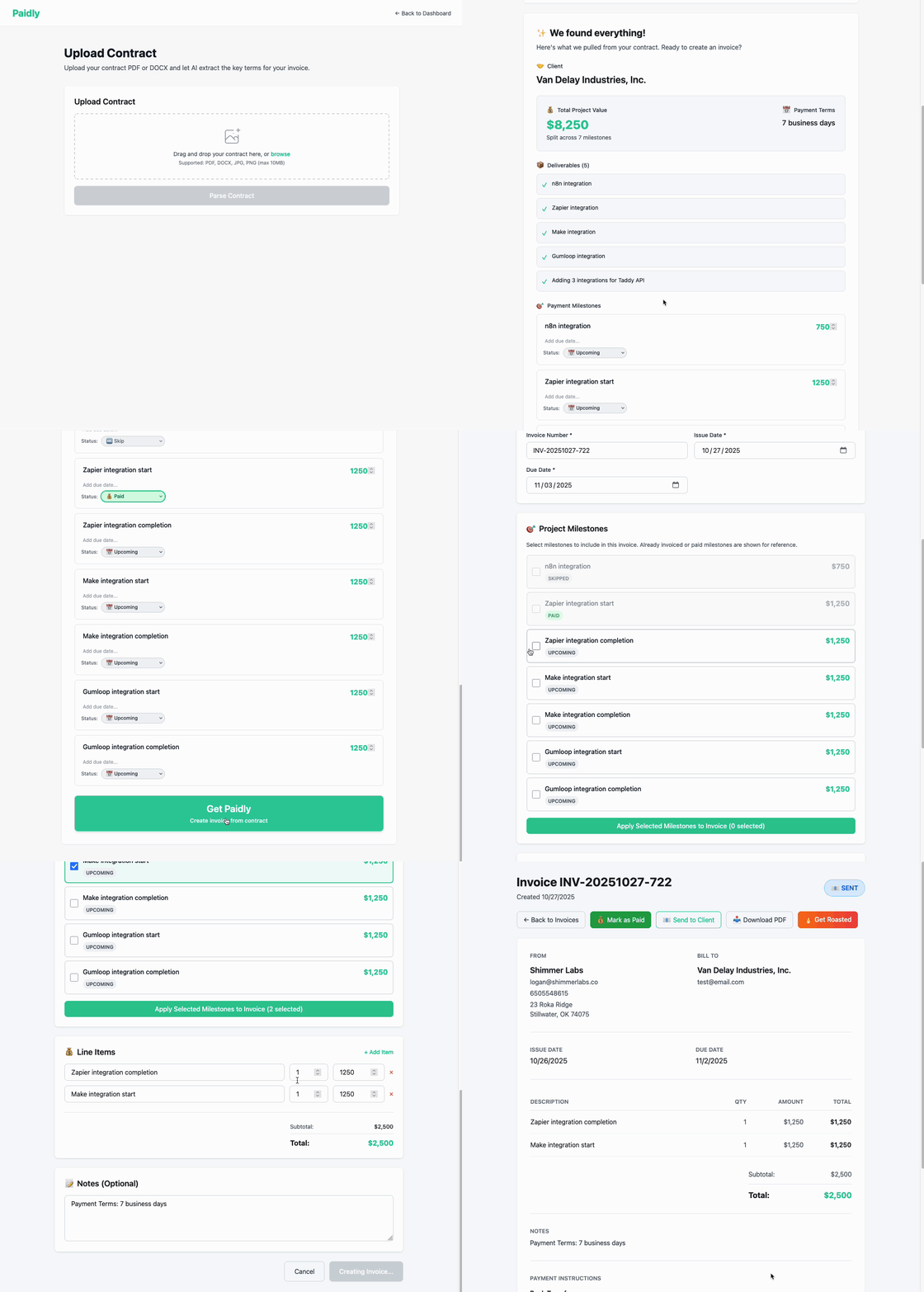
Drop a contract in. Structured data comes out.
Confidence-scored extraction
Every field the parser extracts carries a confidence score. The fields the model is sure about (client name from a signature block, date from a header) pass through. The ones it is less sure about (a payment term written out in prose, a late fee clause buried in a paragraph) surface to a human for review.
This is the part that makes the product honest. An AI that says "I am 98 percent sure this rate is $150 an hour" is usable. An AI that just says "$150 an hour" and is confidently wrong is a lawsuit. We ship the uncertainty to the human, where it belongs.
Current parsing accuracy is 95 percent across two months of pre-launch testing, still holding in production.
Invoice generation with a human in the loop
Review the extracted fields. Adjust anything flagged low-confidence. Click "Get Paidly." A branded invoice goes out to the client with a Stripe payment link, a clean email, and due dates that match the contract. The whole flow, from contract upload to send-ready invoice, takes under 60 seconds.
The review step is not optional. It is the guardrail. Nothing reaches a client until a human has signed off on it. That is the pattern we believe in for any AI that touches money: AI extracts, human approves, system delivers.
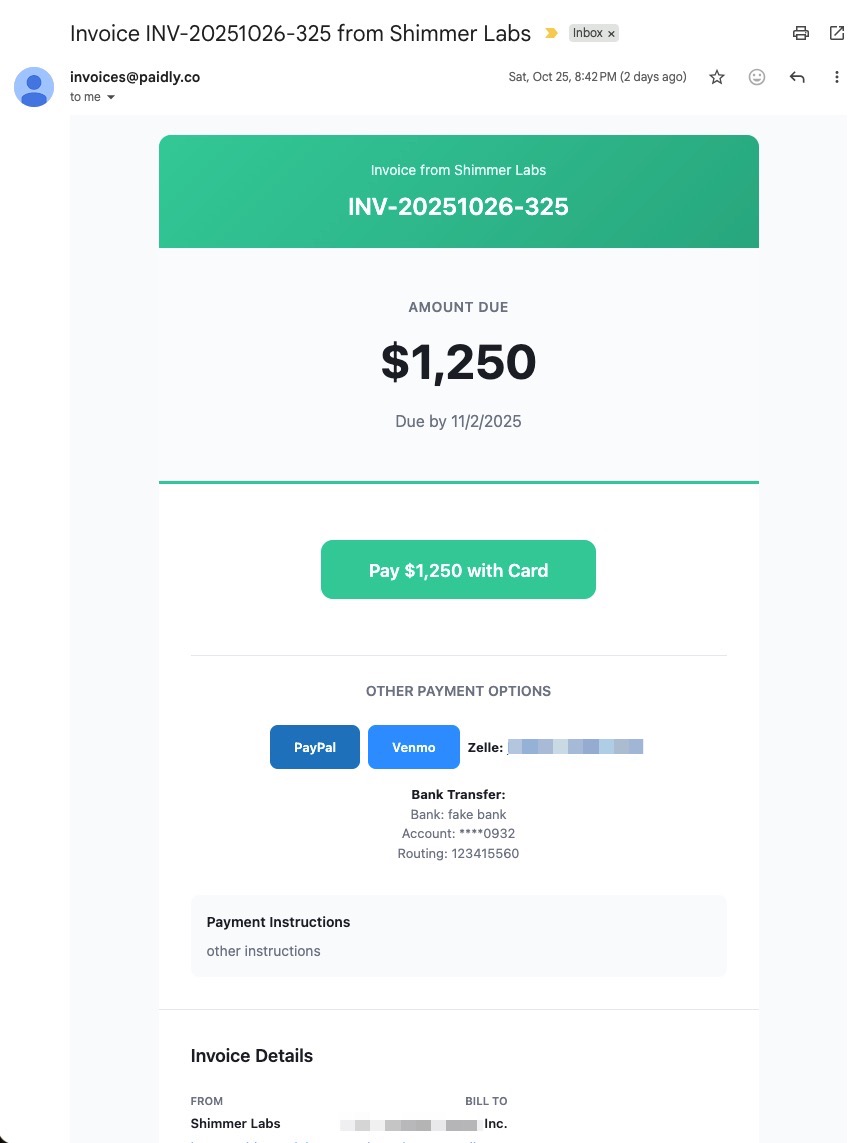
The invoice a client receives. Stripe link, alternate payment options, clean.
AI Invoice Roast
Upload a contract. Paidly tears it apart. Underpriced rates, missing payment terms, scope-creep landmines, IP giveaways, the whole buffet. You get a verdict (undercharging, about right, overcharging), a contract protection score, and a market-reality benchmark telling you what you should actually charge.
It is the same parsing engine from contract ingestion, pointed at a different question. Not "what does this contract say?" but "should you have signed this thing?"
Originally built as a joke. Turns out freelancers really want their contracts roasted before they sign them, and small teams use it in negotiations to push back on underpriced scope.
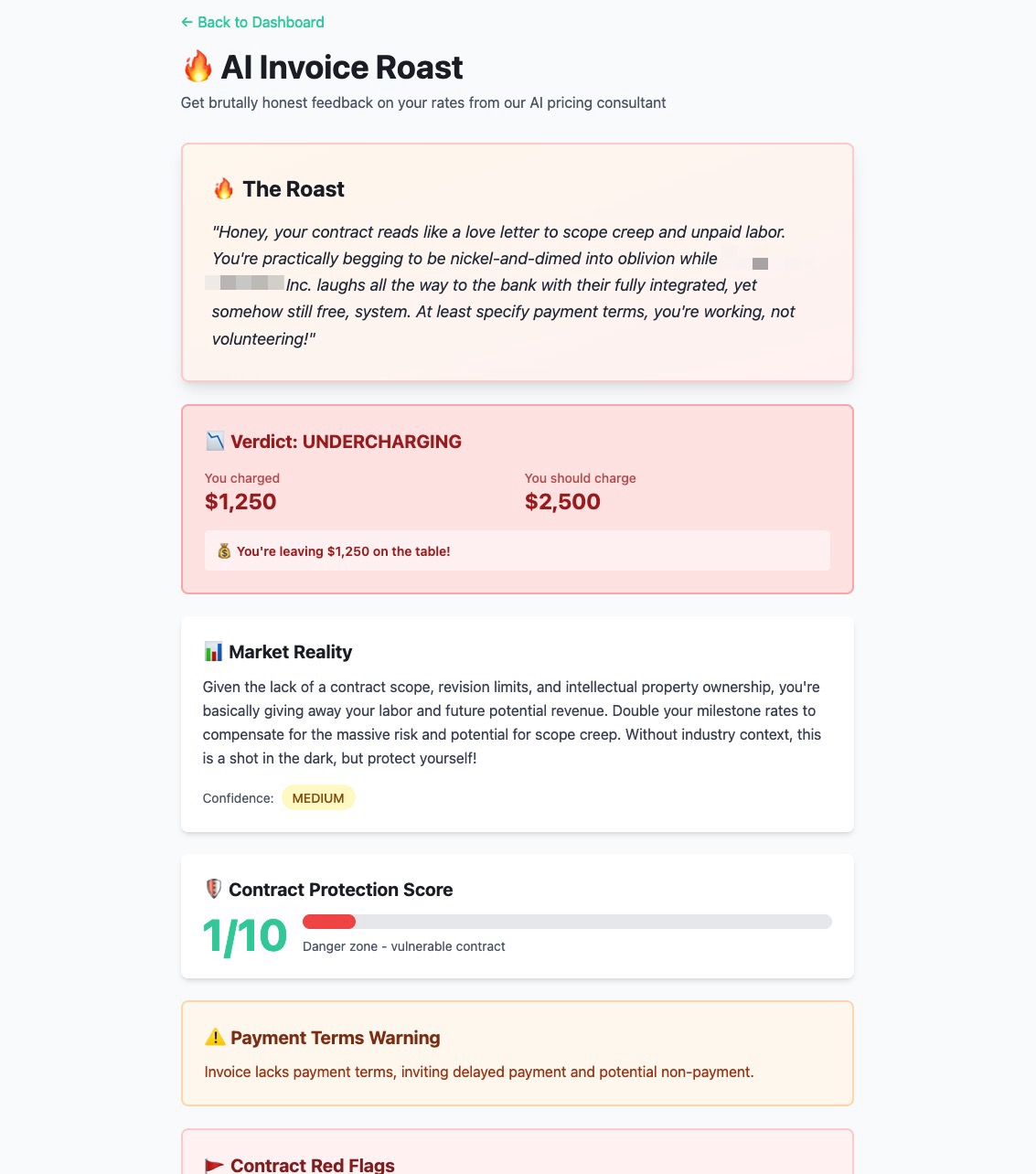
The AI pricing consultant. Spicy, specific, free.
Works where you work
Paidly is a web app at paidly.co, a Chrome extension on the Chrome Web Store, and a Notion integration.
The web app is home base. The Chrome extension scans a contract from inside any browser tab (a Gmail attachment, a doc in Google Drive, a page in Notion) without breaking flow. The Notion integration lets power users trigger Paidly from a Notion database.
Distribution matters. A SaaS that lives only on its own URL fights for attention. A SaaS that shows up in the tools you already use is where the friction actually goes away.
Also shipped along the way
Infrastructure that made the product safe to trust:
- An eval harness for measuring parsing accuracy against a known-good dataset. Shipped the product once it hit 95 percent, and kept running evals to catch regressions.
- Multi-file-type support (PDF, DOCX, image). Contracts come in however the vendor sent them.
- Supabase row-level security so every customer's data is isolated at the database layer, not just the application layer.
- Stripe Connect integration for payment links. Clients pay directly. Paidly never holds funds.
- Cost engineering. AI spend per parse dropped from about $0.01 on Claude to $0.0002 on Gemini 2.0 Flash-Lite. That delta is the difference between a SaaS that works and a SaaS that doesn't.
Two months of testing before ship. Six months in production. What the numbers look like:
Paidly is a small, validated SaaS, not a rocket ship. Thirty-three users is the point. Real product, real revenue, not a press release. The numbers that matter are the ones that prove the capability works: the AI reads the document, the human stays in the loop, and the unit economics hold at a small-business price. Every one of those is a requirement for the same capability to work on an oil and gas vendor invoice, a landscaper's monthly bill, or a property manager's maintenance statement.
Anything AI does to an invoice has to beat a human doing the same task, or no one uses it. The ship gate was 95 percent. Anything less, we were not shipping.
What changed for Logan
I do not retype contracts anymore. Paidly does. Thirty-three other freelancers are paying to have their contracts read instead of reading them themselves. That is what changed for me.
What changed for Shimmer Labs is bigger. We built Paidly to solve one invoicing problem. We learned a repeatable capability along the way: turn any long business document into structured data, with a human in the loop.
Paidly started as my own problem. It ended as a pattern we can apply to anyone else's.
The pattern is portable. Unstructured business document in, structured accounting data out, human in the loop. Swap the contract for:
- A vendor invoice coded per well, for an oil and gas operator on WolfePak
- A monthly service invoice coded per property, for a landscaper on YardBook or LMN
- A maintenance invoice tagged per building, for a property manager on Buildium or AppFolio
- A revenue check stub with dozens of owner splits, for an oil and gas accounting team
- An explanation of benefits, for a medical billing clinic
Same technical spine. Different documents. Different target system. Same human in the loop.
If you are retyping documents into software every week, the Paidly pattern applies to you. Shimmer Labs' Sidecar service builds it for you, against your software, with your documents. You drive. We build the sidecar.
Tech Stack
- Next.js
- TypeScript
- Supabase
- Gemini 2.0 Flash-Lite
- Stripe Connect
- Notion API
- Chrome Web Store
Need this for your pile of documents?
Curious what it costs? Learn about the service →